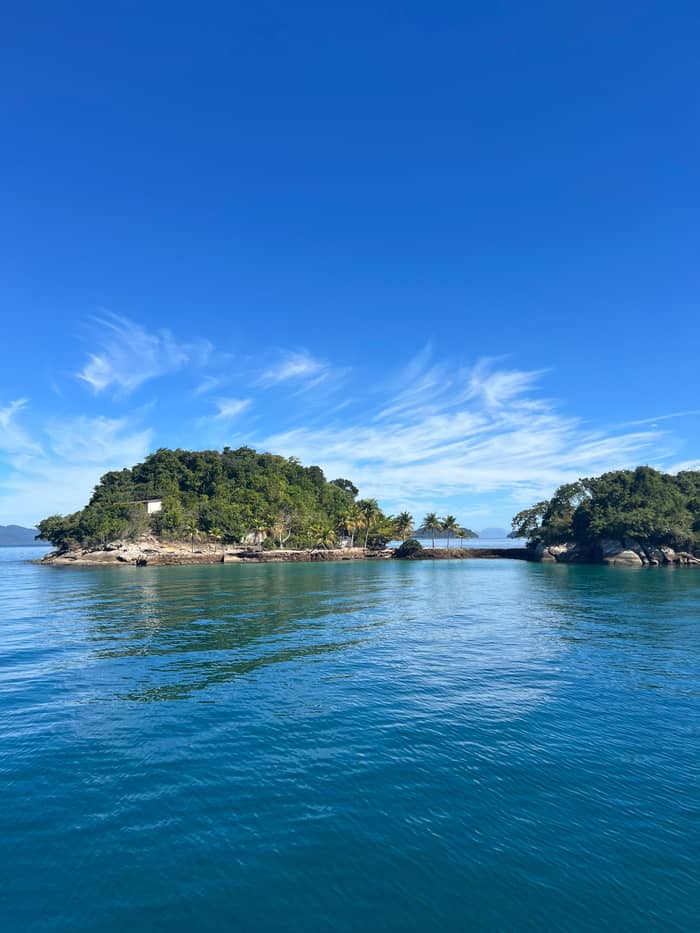
Wet
Summer, December to March
Hot, humid and the wettest
See the day tripChecklist to tick off
List of 9 items
Tick items as you finish them. We save your progress on this device.
0 / 9 ready
You are ready. Only the date and your pickup area are left to choose.
Book your seatThe coast is warm all year and wet in summer. This guide reads the national weather service normals and the state park pages to show what each month brings and how it affects a boat day.
Editorial team, angradosreisboattrip.click · Updated November 12, 2026 · 7 mins to read
Essentials
The Angra dos Reis municipal tourism portal sums the climate up as tropical, with an average annual temperature of 23 C.1 The Rio de Janeiro state park pages for Ilha Grande agree and add detail: the climate is tropical, hot and humid, with no dry season, and rain can fall at any time of year.4,3 For a traveler, that means a swimsuit and a rain layer both belong in the bag.
The state park gives a yearly range of mean temperature between 20 and 26 C, with little variation across the year.5 July is the coldest month at 20.2 C and February the warmest at 26.4 C, and summer means stay above 24 C.5,6 Those numbers match the national weather institute's table for the Angra dos Reis station, which we use below.
For anyone checking Angra dos Reis weather before a trip, what changes the plan is the rhythm of the year rather than whether you can go. The coast is green because it is wet, and the sea is warm enough to be inviting for much of the year. The question is less about the best month than about which trade-off you prefer: heat and showers in summer, or milder, drier days in the middle of the year.
Temperature and rain
| Months | Rain (mm) | Mean (C) | Max and min (C) |
|---|---|---|---|
| January and February | 241.0 and 221.92 | 25.9 and 26.47 | 29.8 and 30.4; 22.6 and 23.18,9 |
| March and April | 233.4 and 163.82 | 25.7 and 23.87 | 29.5 and 27.6; 22.5 and 20.88,9 |
| May and June | 105.3 and 74.32 | 22.1 and 20.77 | 26.2 and 25.0; 18.9 and 17.18,9 |
| July and August | 71.9 and 78.92 | 20.2 and 20.87 | 24.6 and 25.0; 16.5 and 17.28,9 |
| September and October | 109.0 and 152.12 | 21.4 and 22.37 | 24.9 and 25.6; 18.2 and 19.38,9 |
| November and December | 171.0 and 261.12 | 23.5 and 24.97 | 27.0 and 28.6; 20.4 and 21.78,9 |
INMET normals 1961-1990 for station 83788; each pair lists the first month, then the second; the maximum is listed before the minimum.2
The national meteorological institute, INMET, publishes climate normals for station 83788 in Angra dos Reis, averaged over 1961 to 1990.2 Read it as the typical pattern, not as a forecast. In those normals the rainfall runs from 71.9 mm in July to 261.1 mm in December, and the year adds up to 1883.6 mm.2
The same normals give the mean temperature at 25.9 C in January, 26.4 C in February and 25.7 C in March, falling to 20.7 C in June, 20.2 C in July and 20.8 C in August.7 The mean maximum is 30.4 C in February and 24.6 C in July, and the mean minimum is 23.1 C in February and 16.5 C in July.8,9 So a July day is mild and a February day is hot.
Rainfall follows the temperature. January has 241.0 mm, February 221.9 mm and March 233.4 mm, April drops to 163.8 mm, and May is 105.3 mm.2 The driest months run from June at 74.3 mm to September at 109.0 mm, then the rain returns with October at 152.1 mm and November at 171.0 mm.2 The chart and the table on this page show the months side by side.
Rain by month
INMET Climate Normals 1961-1990, station 83788 Angra dos Reis, rainfall in millimeters, with selected months shown.2
Ilha Grande is wet through the year, and the state park says why. The island is subject to rain all year, with the greatest concentration in summer, from December to March, and the least in winter, from June to August.3 The park adds that the variation of the rain across the year comes mainly from the disturbances of cold fronts and tropical fronts.11
In summer, expect heat first and showers second. The mean maximum reaches 29.8 C in January and 30.4 C in February, and the park notes summer mean temperatures always above 24 C.8,6 That is the season of warm sea, high humidity and the most rain, so plan for a downpour and a bright afternoon in the same day.
In winter, the fronts bring cooler spells. The mean minimum falls to 16.5 C in July, and the mean maximum to 24.6 C, which is still pleasant by the shore.9,8 Mornings can feel cool on the water, so bring a light jacket, a point that one private speedboat listing also makes for days when the weather is not perfect.
Pick your month
Say what you want most and see which months to look at.
If I want the driest weather
June to August
The park gives the lightest rain in those months.3
If I want the warmest air and water
December to March
Mean temperatures stay above 24 C in summer.6
If I want to hike the hard trails
A dry winter day
Pico do Papagaio needs a rain-free day with few clouds.10
If I have only a short stay in Rio
Any month, flexible
The site tour runs in bad weather, from $75.
If I want to avoid wet afternoons
Winter or the shoulder months
July has 71.9 mm of rain in the normals.2
Seasons
Wet
Hot, humid and the wettest
See the day trip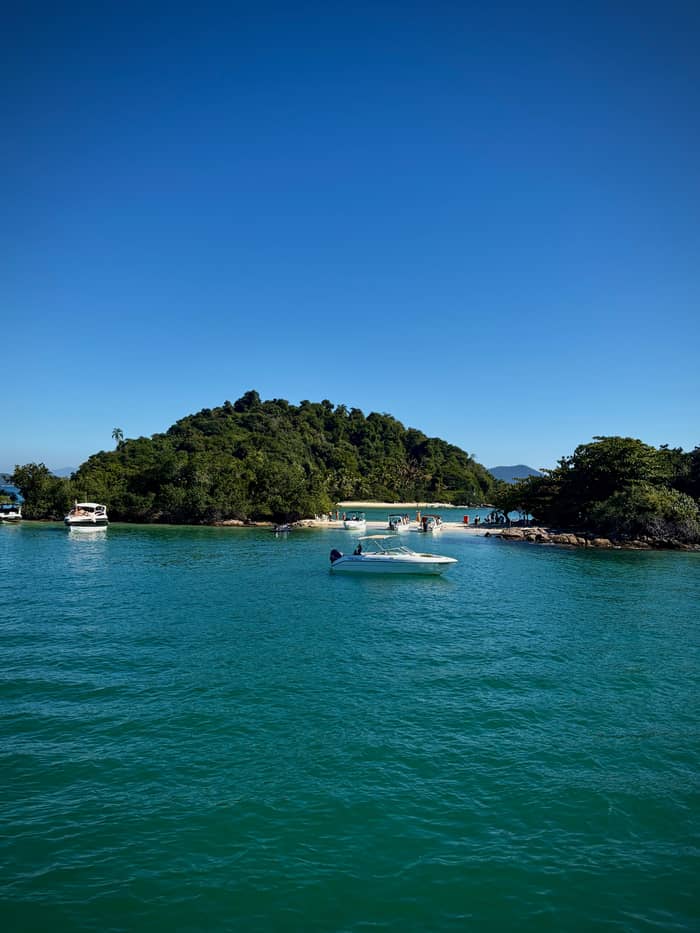
Drier
Milder and drier
See the day trip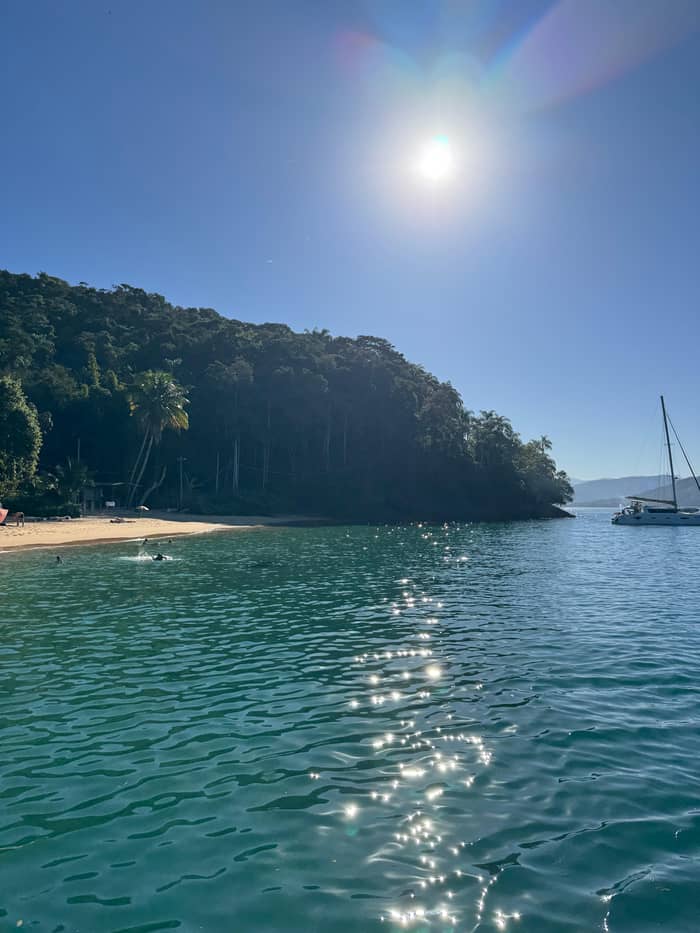
Between
April, May, September to November
See the day tripIf you want the driest trip, aim for the winter months. The park places the lightest rain between June and August, and the INMET normals show 74.3 mm in June, 71.9 mm in July and 78.9 mm in August, against 261.1 mm in December.3,2 Those months also keep the mean temperature near 20 C, from 20.2 to 20.8 C, a comfortable range for walking the trails.7
If you want the warmest water and sun, choose summer and accept showers. January to March are the hottest months, with mean temperatures from 25.7 to 26.4 C, and they are also the wettest, so pick a flexible date.7,3 A boat day can still run: the site tour operates in bad weather and a cancellation comes only if the Navy refuses clearance to sail.
For a balance, look at the shoulder months. April has 163.8 mm and May 105.3 mm, September 109.0 mm and October 152.1 mm, which sits between the extremes.2 The right answer depends on whether you prefer swimming in a warm sea or walking in cooler, drier air, and on how much a possible shower matters to you.
The year in order
December to March
February
The mean temperature reaches 26.4 C.5
April and May
Rain eases from 163.8 mm in April to 105.3 mm in May.2
June to August
The lightest rain of the year, according to the park.3
July
The mean temperature falls to 20.2 C.5
October and November
Monthly rain climbs to 152.1 mm and 171.0 mm.2
Operators say plainly that the sea and the weather set the plan. Weather alone rarely cancels the site tour, which is called off only in exceptional cases if the Navy will not release the vessel. A boat-and-lunch day and the shared speedboat tours from Angra describe themselves as running rain or shine.
Other listings keep more room to move. One Rio boat tour says it depends on favorable weather, that routes may change with maritime conditions and Navy intervention, and that if it is cancelled for lack of travelers the provider offers another date or a full refund. The Angra lagoons tour lists weather and sea conditions among the reasons it may adjust, and offers a change of time or date.
For your own protection, read the weather clause of the listing you choose, and use the free cancellation window. Each of them lets you walk away without charge until 24 hours before the start. Look at the forecast several days ahead and again on the evening before, and decide before the cut-off whether the day still suits you.
Video
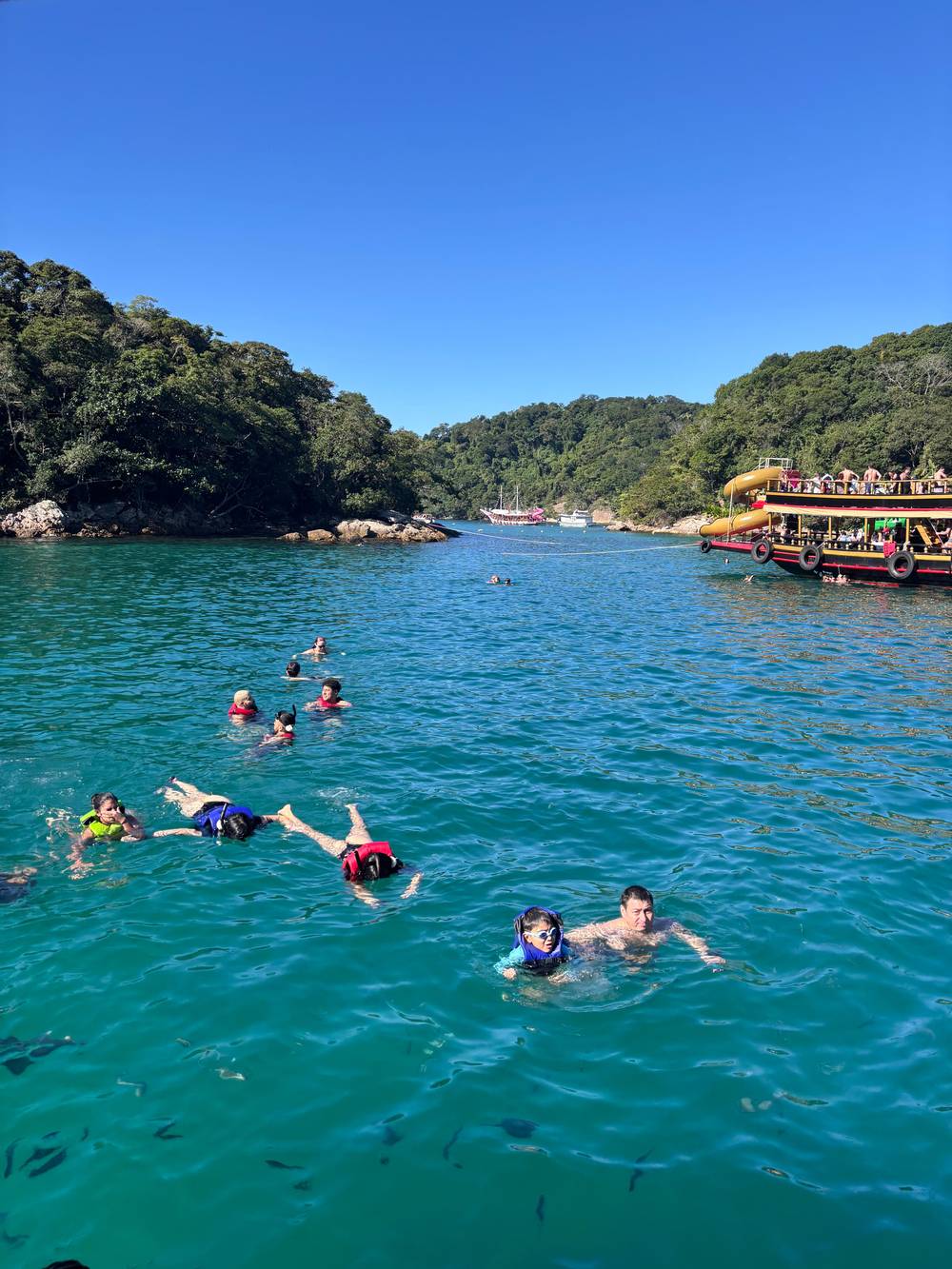
Demi on the Road on YouTube · Tap play to load the video; not before.
Ilha Grande is subject to rain all year, with the greatest concentration in summer, from December to March, and less in winter, from June to August.
A rainy day on Ilha Grande is a day for the village rather than the trails. The state park warns that the ground on the Pouso to Lopes Mendes path needs care in the rain, and that the climb to Pico do Papagaio needs a day without rain and few clouds, started before noon.12,10 So move the big walks to a dry day and keep the wet day for short, safe outings.
History is a good rainy-day theme. For a short wet-day outing, the 1.8 km Abraão circuit takes about 1h30 and passes the old aqueduct and the Lazareto ruins, a quarantine hospital that worked from 1886 to 1913.13,14 Dress for rain, keep to the marked path, and go back when the downpour is heavy, since wet ground makes the short walk slower and more slippery than the numbers suggest.
Eating, resting and planning also count. Vila do Abraão offers the widest choice of inns, restaurants and agencies, so a wet afternoon passes easily over a long lunch and a check of the next forecast.15 If you are on a boat day from Rio, expect the tour to run, since the listing says it operates in bad weather, and bring a light rain layer and a dry change of clothes.
Sun protection comes first in every season. The Angra speedboat listing recommends sunscreen and a hat, and it asks guests to carry money for food and drink. The site tour advises snacks and water for the coach, since lunch comes in the afternoon. A swimsuit, a towel and a dry set of clothes round out the day pack.
For summer, add a light rain layer and quick-dry clothes, and keep electronics in a waterproof pouch. For winter, add a thin jacket for the boat and a long-sleeved top, since the INMET normals show mean minimums near 16.5 C in July.9 For shoulder months, bring both, and wear shoes with grip if you plan to walk.
Finally, build slack into the plan. Choose a date with free cancellation, keep a rain-day idea ready, and follow the operator's message on the day before departure, which the site tour sends by WhatsApp with the boarding details. Our page on the day trip hour by hour explains how that day unfolds, and the page on getting to Ilha Grande covers the crossings.
FAQ
July has 71.9 mm of rain in the 1961 to 1990 normals for the Angra dos Reis station.2
The same INMET normals put December at 261.1 mm and the year at 1883.6 mm.2
The park says rain falls all year, heaviest from December to March and lightest from June to August.3
The site tour operates in bad weather; the Navy can stop a departure in exceptional cases.
Sources
Planning a day on the water at Angra? Ask a real person here.